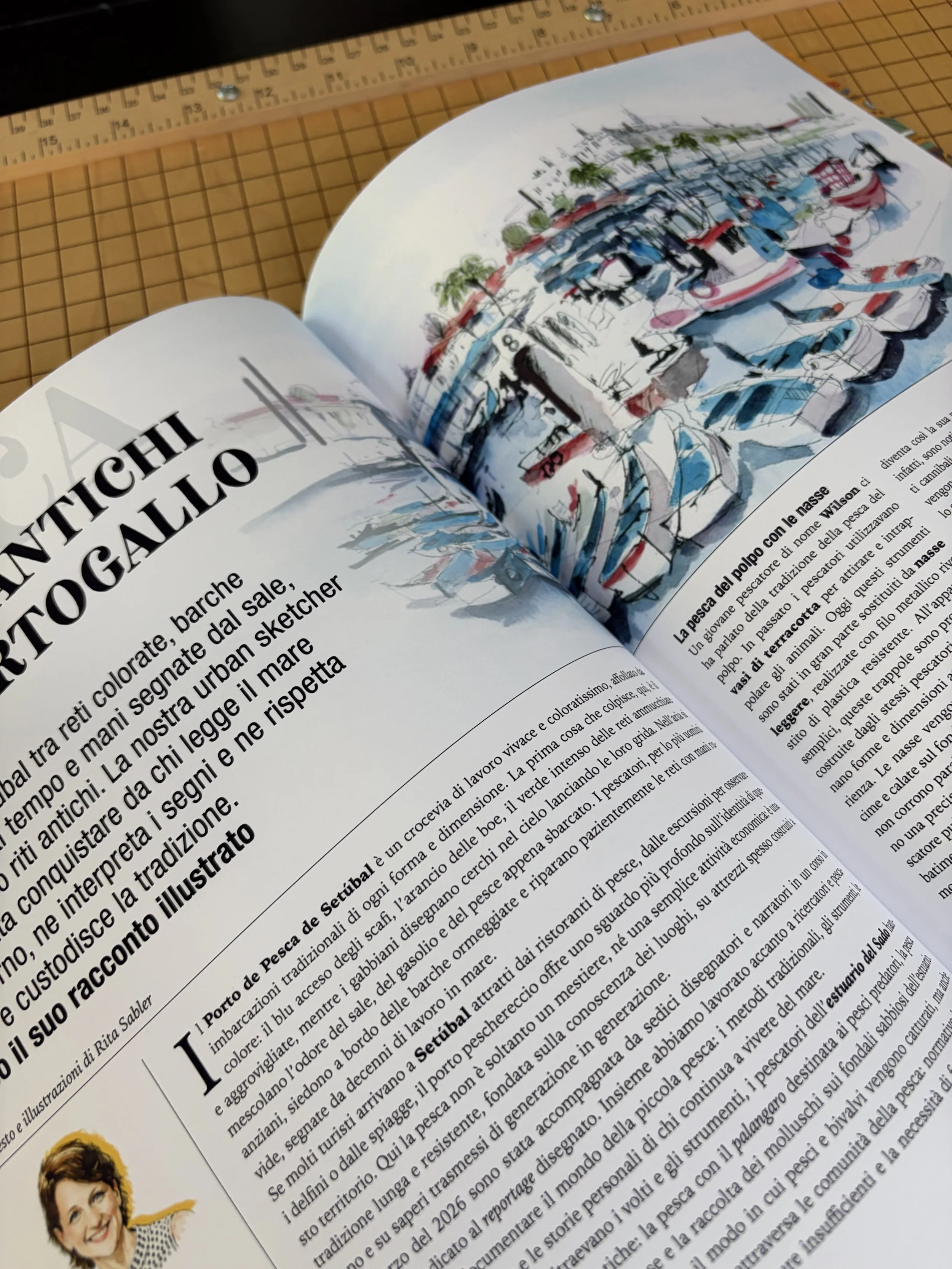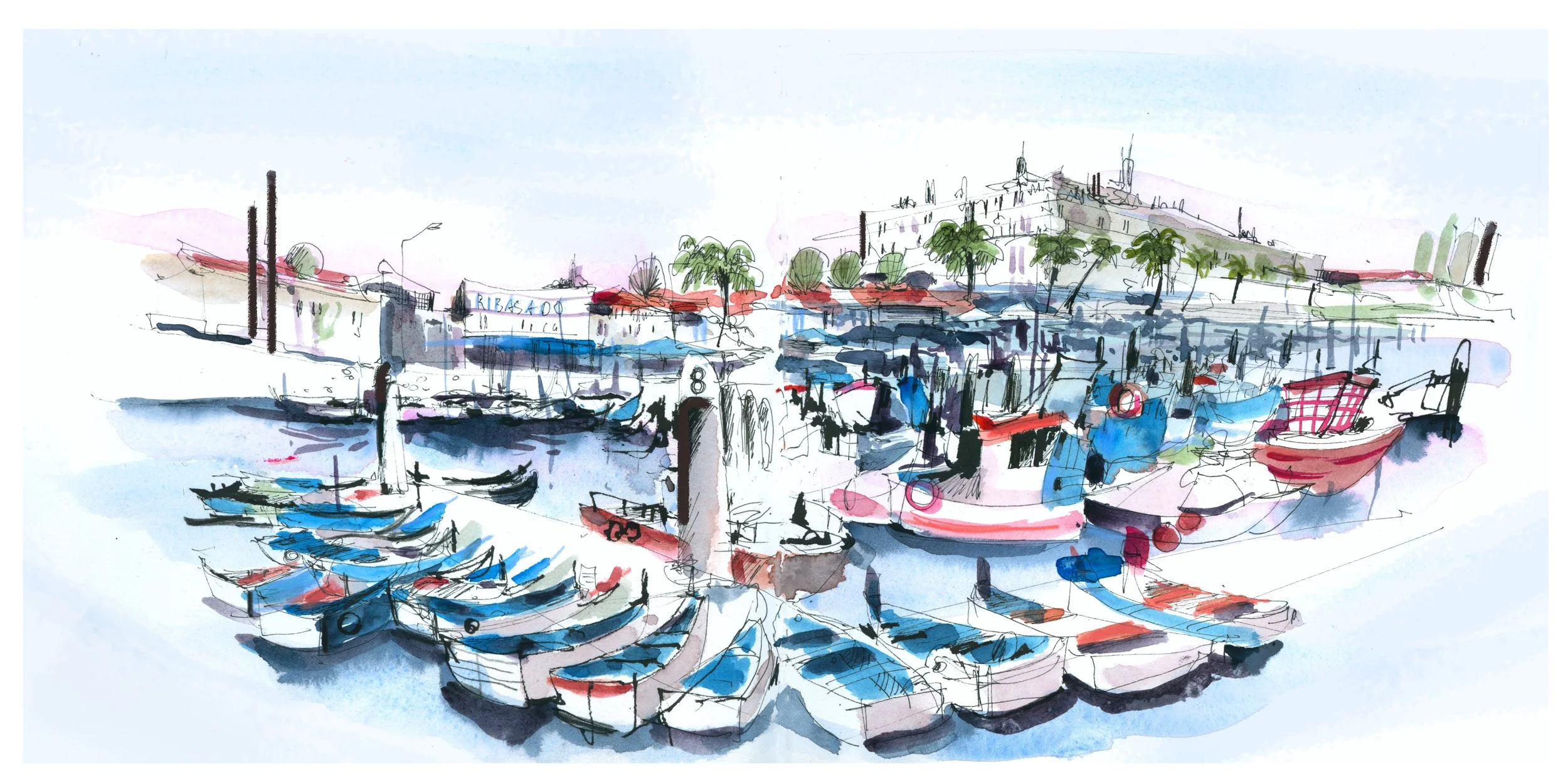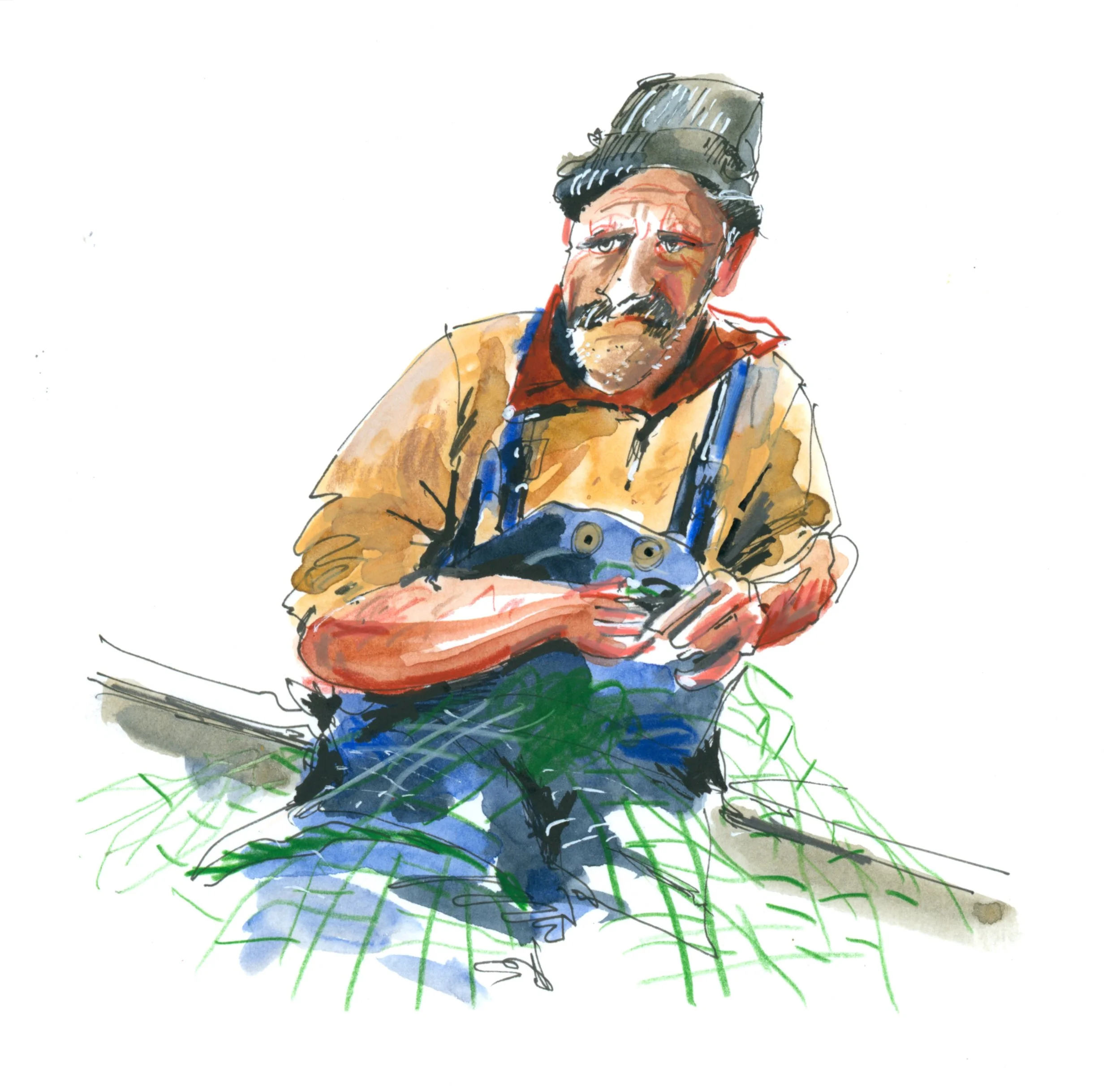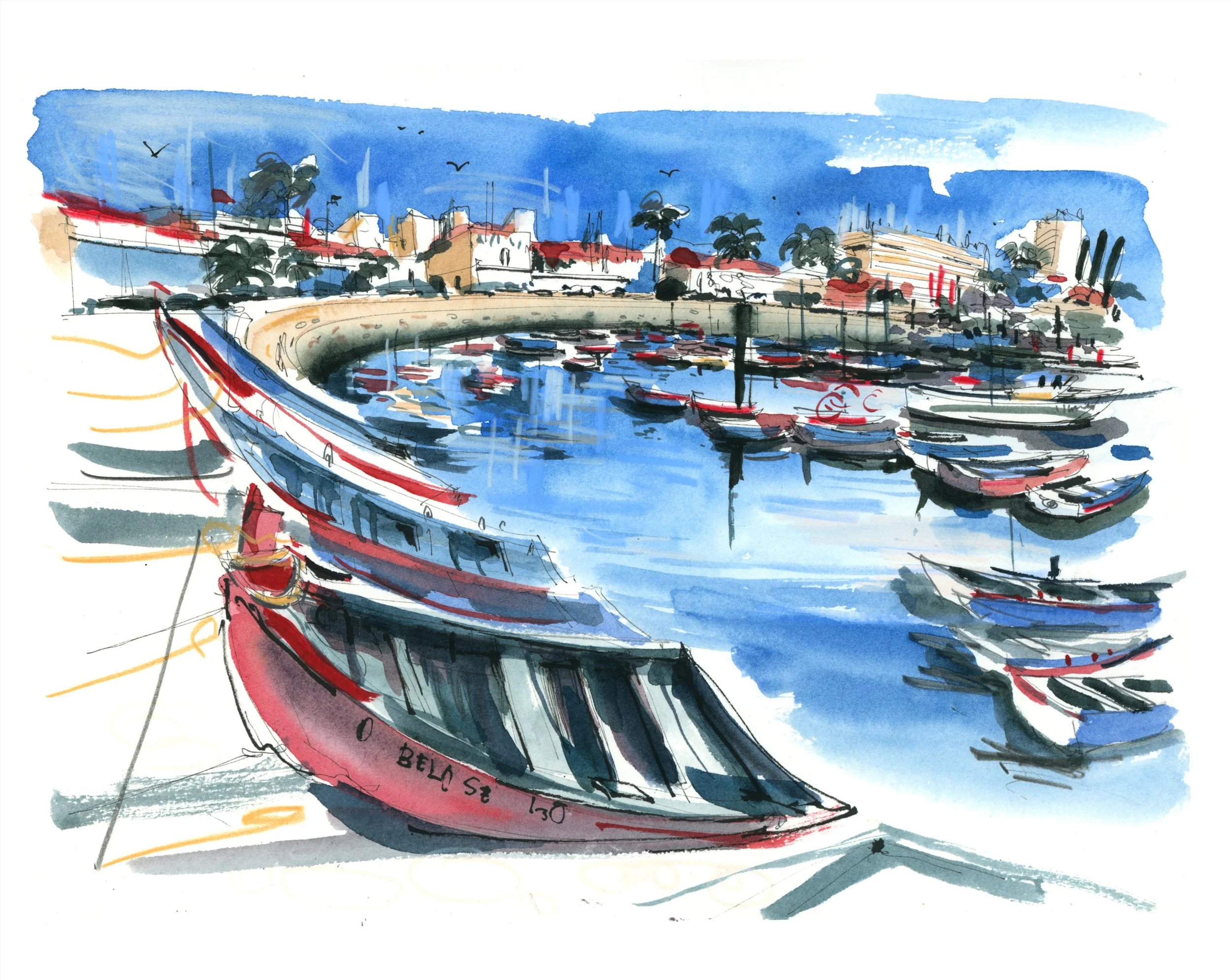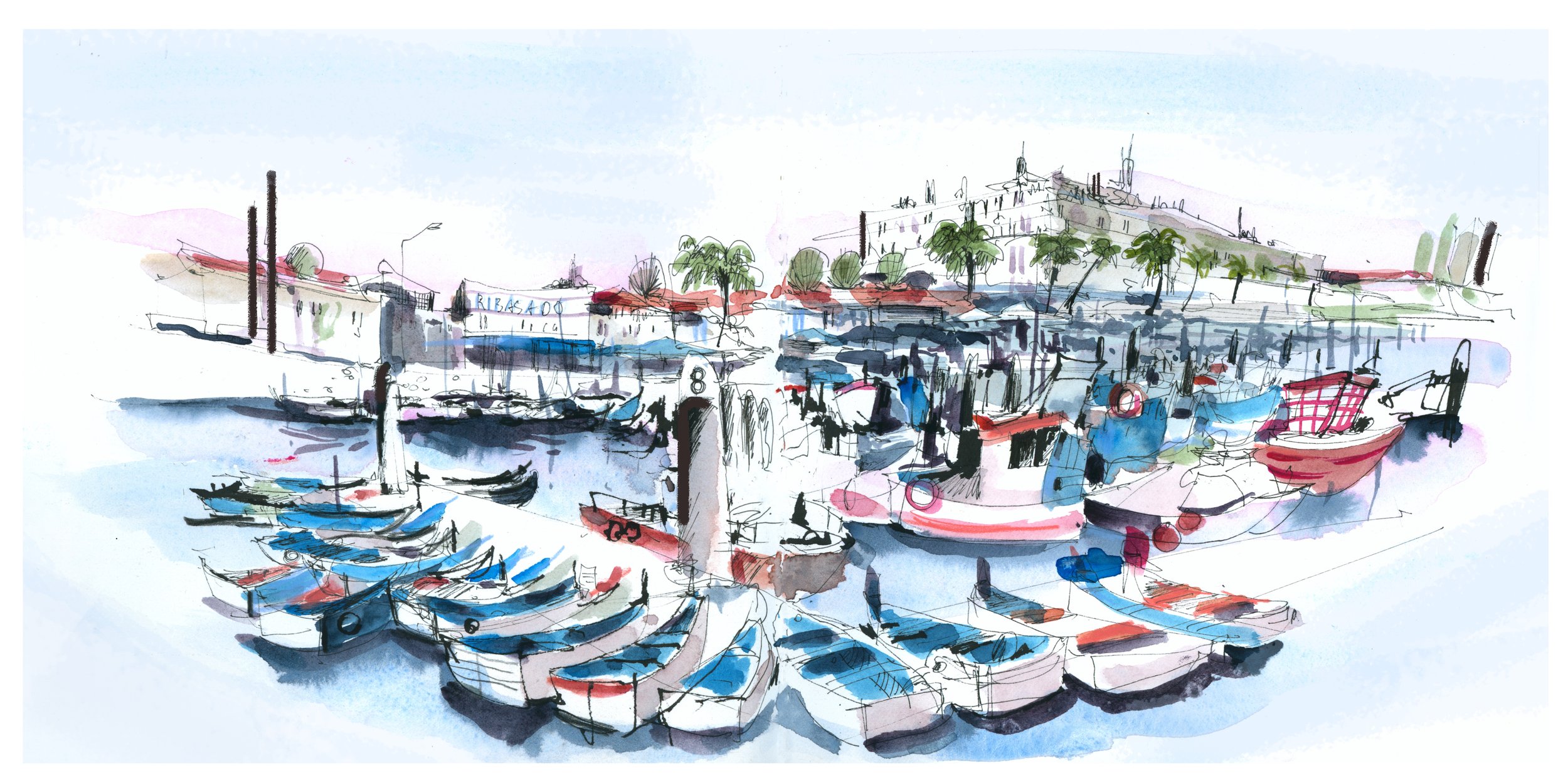
Porto de Pesca de Setúbal is a colorful working harbor crowded with traditional fishing boats of every size and shape. The first thing you notice here is the color. Bright blue boats, orange buoys, and heaps of tangled green nets beneath the cries of gulls circling in the sky. The air smells of salt, diesel, and fresh fish. Fishermen, mostly older men, sit aboard their moored vessels, patiently repairing nets with rough hands shaped by decades of work at sea.
While tourists often come to Setúbal for its seafood restaurants, dolphin-watching excursions, or the beaches, the working harbor offers a deeper glimpse into the region's identity. Here, fishing is not simply a hobby or a business—it is a long tradition sustained by local knowledge, handmade gear, and knowledge passed from one generation to the next.
In March 2026, I was joined by sixteen sketchers and storytellers for an in-person course in drawn reportage. Together, we worked alongside researchers and local fishers to document the world of small-scale fisheries: their traditional fishing methods, tools, daily routines, and personal stories.
As my students sketched their portraits and their tools, fishermen from the Sado Estuary shared insights into three distinct methods: longline fishing for predatory fish, traditional octopus trapping, and shellfish harvesting on the estuary's sandy seabed. Their stories revealed not only how fish and shellfish are caught, but also the challenges facing modern fishing communities—from changing regulations and aging fleets to the need for practical training for the next generation.
Octopus Trapping
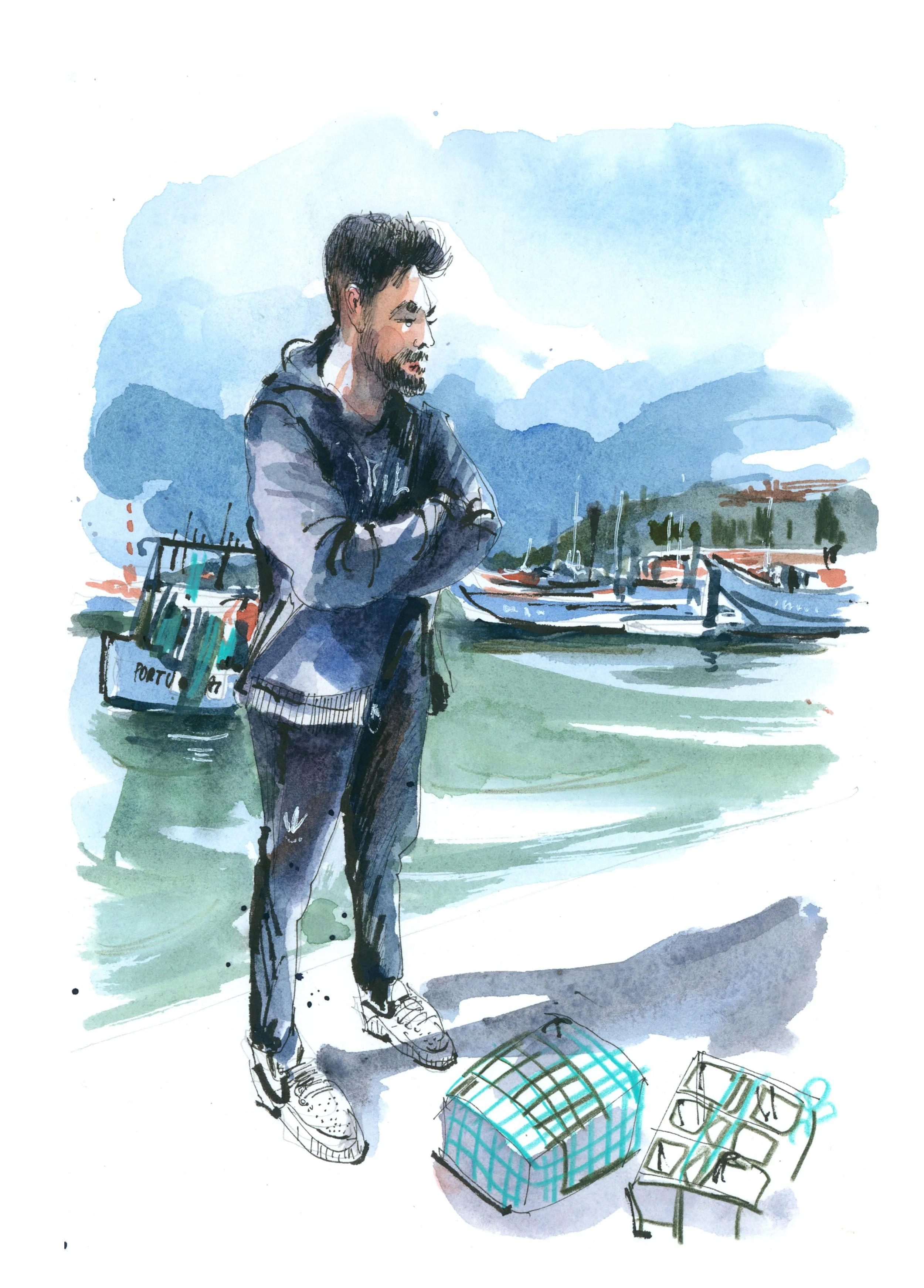
A young fisherman called Wilson talked to us about the traditional practice of octopus fishing. In earlier generations, fishermen used clay pots to attract and trap octopus. Today, these have largely been replaced by lightweight cages made from durable plastic-coated wire. Simple in appearance, the traps are designed and built by the fishermen themselves, with dimensions and shapes refined through experience.
The traps are attached to long ropes and deployed along the seabed. Rather than running parallel to the coastline, these lines typically follow a specific depth contour. A fisherman might set traps along the 50-meter contour, tracing the natural shape of the seabed to ensure that every trap lies within suitable octopus habitat.
Interestingly, larger traps do not necessarily catch larger octopus. Sometimes a bigger one might enter the trap already occupied by a smaller octopus, who becomes its prey–these animals are known to be cannibals. But typically, the traps are baited with oily fish such as mackerel.
Most traps remain on the seabed for about 24 hours before being retrieved, although weather conditions and expectations of a strong catch can influence timing. When fishing is particularly productive, some fishermen may return after only 18 hours.
The number of traps a vessel may operate depends on both its size and licensing regulations. Smaller boats are often permitted to deploy several hundred traps distributed across multiple lines, with dozens of traps attached to each one.
One advantage of octopus trapping is its versatility. The gear can be used across a wide range of seabed types, including rocky areas where nets would easily become damaged or snagged. This allows fishermen to work grounds that are inaccessible to many other fisheries.
As Wilson emphasized, success depends not only on equipment but also on intimate knowledge of local conditions, seabed characteristics, weather patterns, and seasonal changes.
Harvesting the Sands
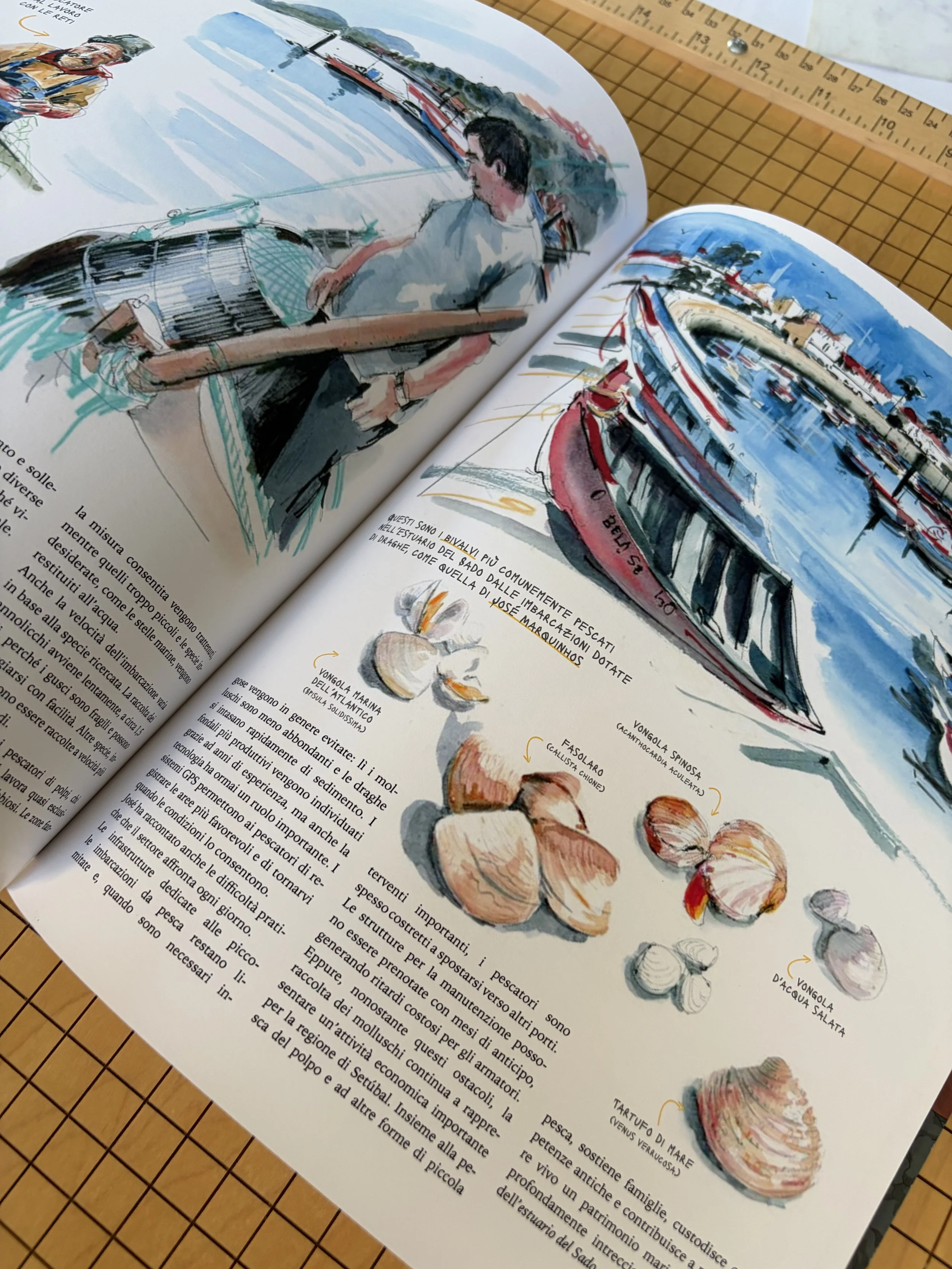
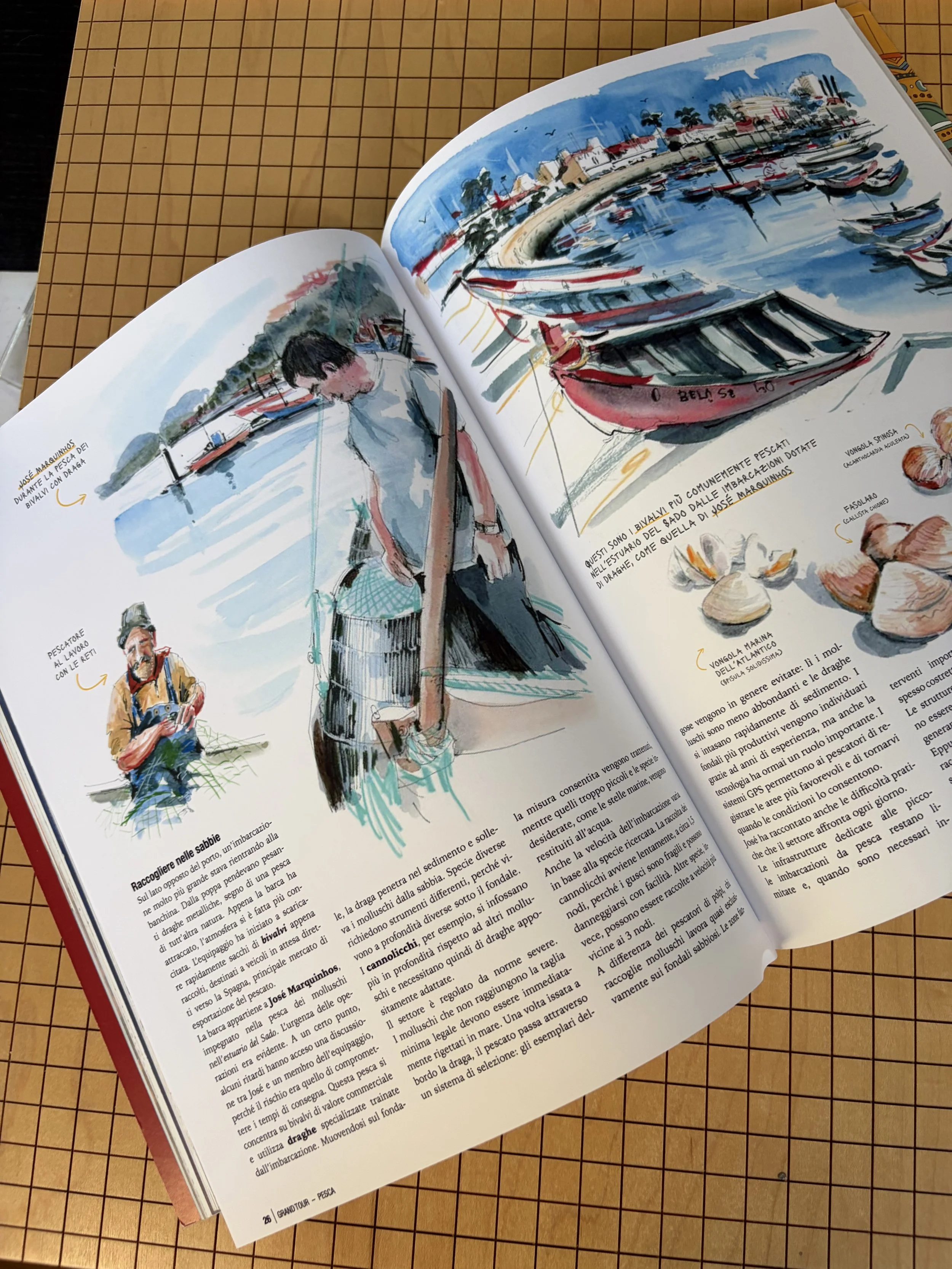
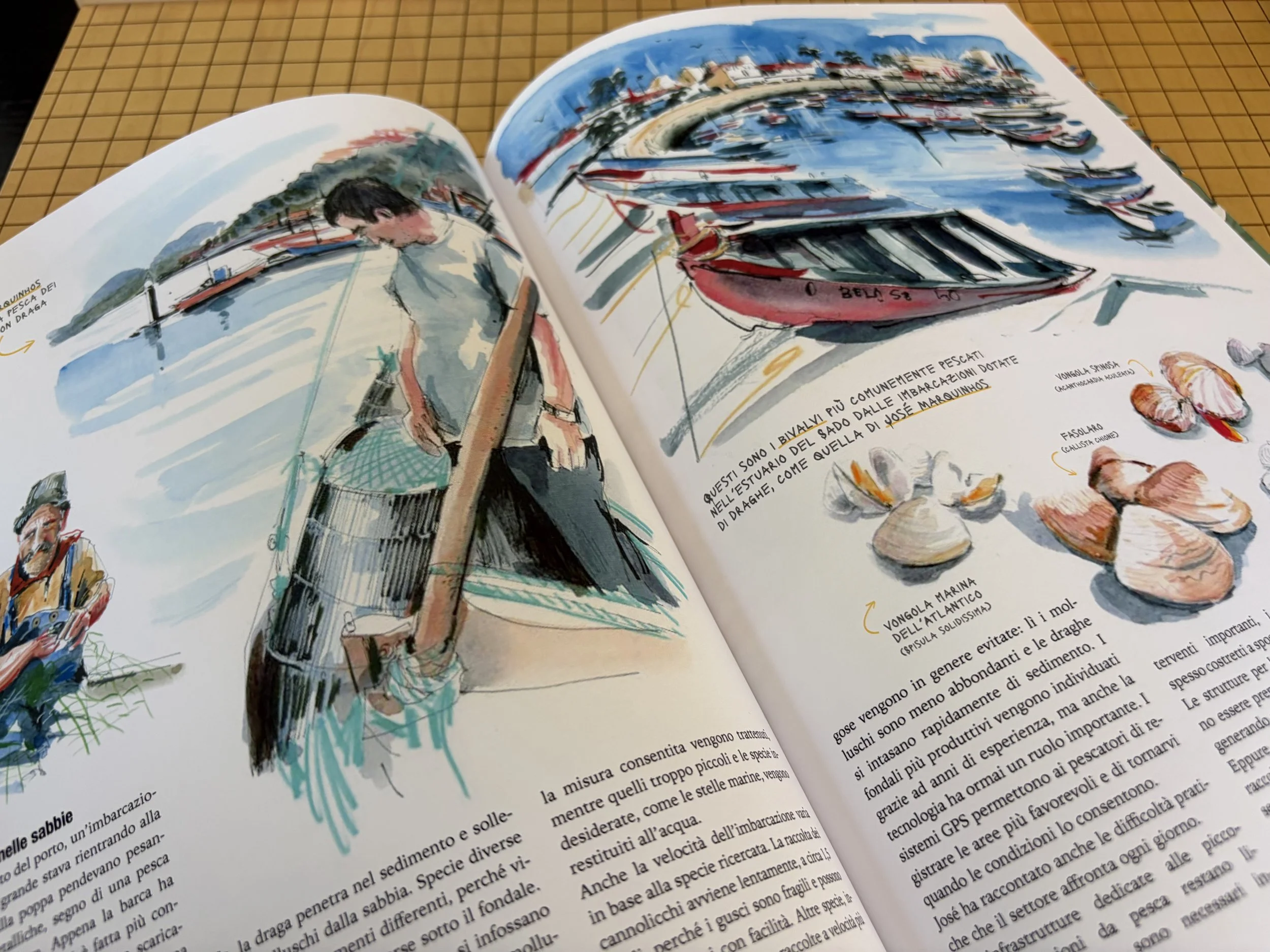
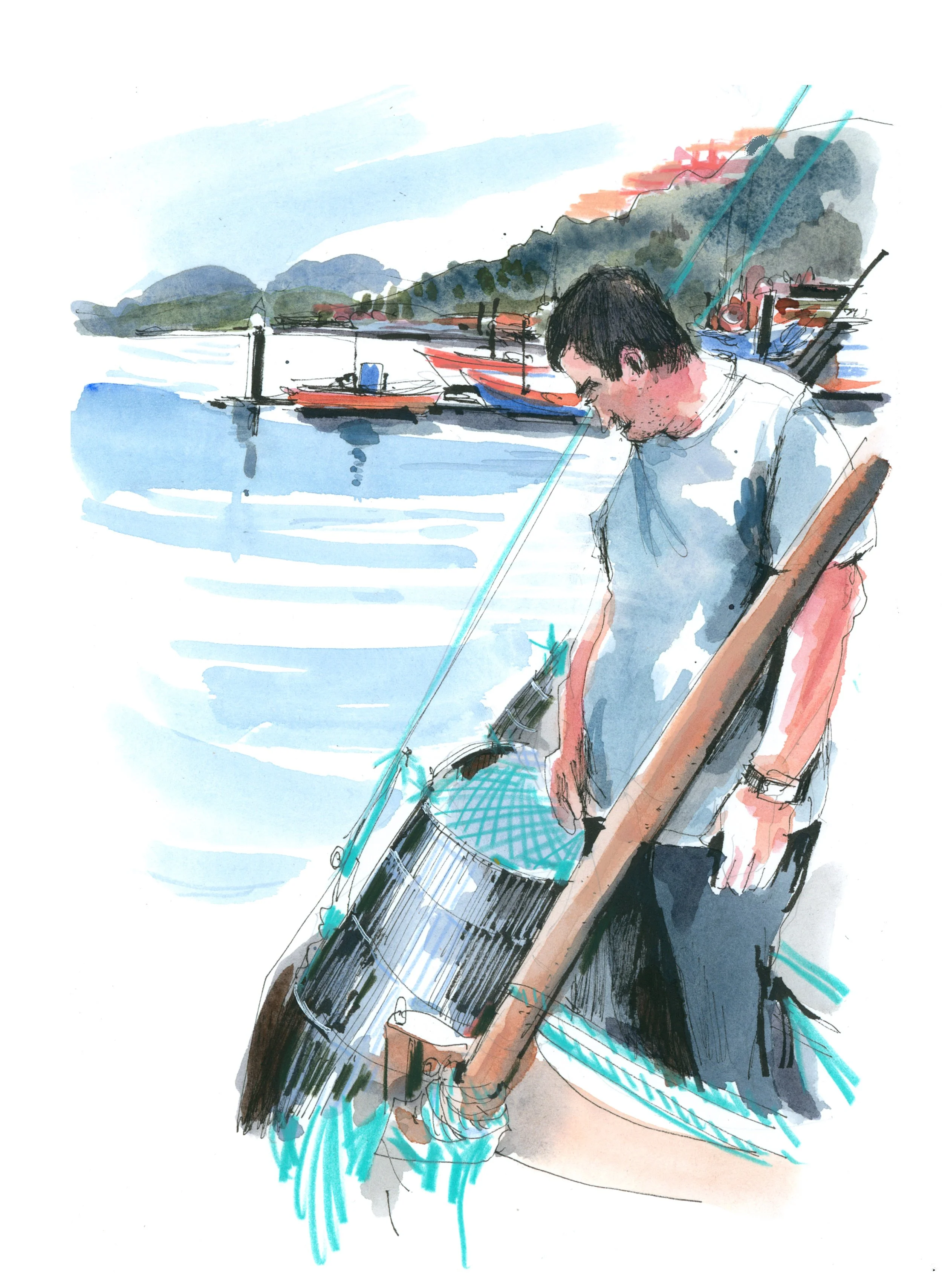
On the opposite side of the harbor, a much larger vessel was returning to the quay. Heavy metal dredges hung from its stern, evidence of a very different kind of fishing. As the boat docked, the atmosphere became more frantic. Crews hurried to unload sacks of freshly harvested bivalves onto waiting vehicles destined for Spain, the principal export market for the catch.
The dredging boat belongs to José Marquinhos, who works in the Sado Estuary shellfish fishery. The urgency of the unloading process was clear. At one point, José became embroiled in a heated discussion with a crew member after delays threatened to jeopardize a delivery deadline.
The shellfish fishery targets commercially valuable bivalves using specialized dredges towed behind the vessel. As the dredge moves across the seabed, it penetrates the sediment and lifts shellfish from the sand. Different species require different equipment because they live at varying depths beneath the seabed. Razor clams, for example, burrow deeper than many other shellfish and therefore require specially adapted dredges.
Strict regulations govern the fishery. Shellfish that do not meet the legal minimum size must be returned immediately to the sea. Once the dredge is brought aboard, the catch passes through a sorting system where legal-sized shellfish are retained while smaller and undesirable marine species like starfish are returned to the water.
The speed at which the vessel operates depends on the target species. Razor clam harvesting is conducted slowly, at around 1.5 knots, because the delicate shells can easily be damaged. Other species can be harvested at speeds closer to 3 knots.
Unlike octopus fishermen, shellfish harvesters work almost exclusively on sandy seabeds. Muddy areas are generally avoided because shellfish are less abundant there and dredges quickly become clogged with sediment. Productive grounds are identified through years of experience, but modern technology also plays a role. GPS systems allow fishermen to record successful locations and return to them when conditions are favorable.
José spoke about the practical challenges facing the industry. Infrastructure for small fishing vessels remains limited, and when major repairs are required, fishermen often need to travel to other ports. Maintenance facilities can be booked months in advance, creating costly delays for vessel owners.
Despite these obstacles, shellfish harvesting continues to be an important economic activity in the Setúbal region. Alongside octopus fishing and other small-scale fisheries, it sustains local families and helps preserve a maritime heritage that remains woven into the identity of the Sado Estuary.
Written and illustrated for Grand Tour Magazine
June 2026